
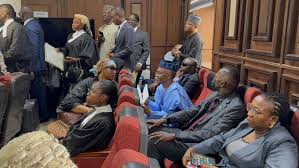
The Federal High Court in Abuja on Monday granted bail to former Kaduna State Governor, Nasir El-Rufai, in the sum of N100 million over alleged violations of national security laws.
El-Rufai is being prosecuted by the Department of State Services (DSS) following comments he allegedly made during a national television interview in which he claimed to have wiretapped the communication of the National Security Adviser, Nuhu Ribadu.
Delivering ruling on the bail application, Justice Joyce Abdulmalik imposed a series of stringent conditions that must be met before the former governor can perfect his bail.
According to the court, the surety must reside in either Maitama or Asokoro districts of Abuja and must provide the original Certificate of Occupancy of a landed property to the court registry.
The court further directed that the surety must be a federal civil servant on Grade Level 17 or above and must submit evidence of salary payments for at least the last three months, alongside a bank authentication letter from the branch manager within the court’s jurisdiction.
Other requirements include a sworn affidavit of means, a signed bail bond, a recent passport photograph, a verification letter from the surety’s department, and a tax clearance certificate covering the last six months.
Justice Abdulmalik also ordered El-Rufai to surrender all valid passports to the court and report to the DSS headquarters on the last Friday of every month at 10 a.m. pending the determination of the case.
The judge warned that any breach of the bail conditions would result in immediate revocation.
In addition, the court directed the former governor to submit a letter of attestation from the Chairman of the Kaduna State Traditional Council.
The court subsequently ordered an accelerated hearing of the matter.
Tension, however, erupted outside the court premises shortly after proceedings ended, as supporters linked to activist and former presidential candidate Omoyele Sowore reportedly clashed with security personnel while El-Rufai exited the complex.
Eyewitnesses described scenes of shouting and commotion as security operatives attempted to control the crowd and maintain order around the courthouse.
The case has continued to generate widespread political and legal reactions, with analysts closely watching its implications for national security discourse and Nigeria’s evolving political landscape.
